

Does More Pain Mean Better Results?
Pain and results are not proportional — how ReYeonK thinks about pain management
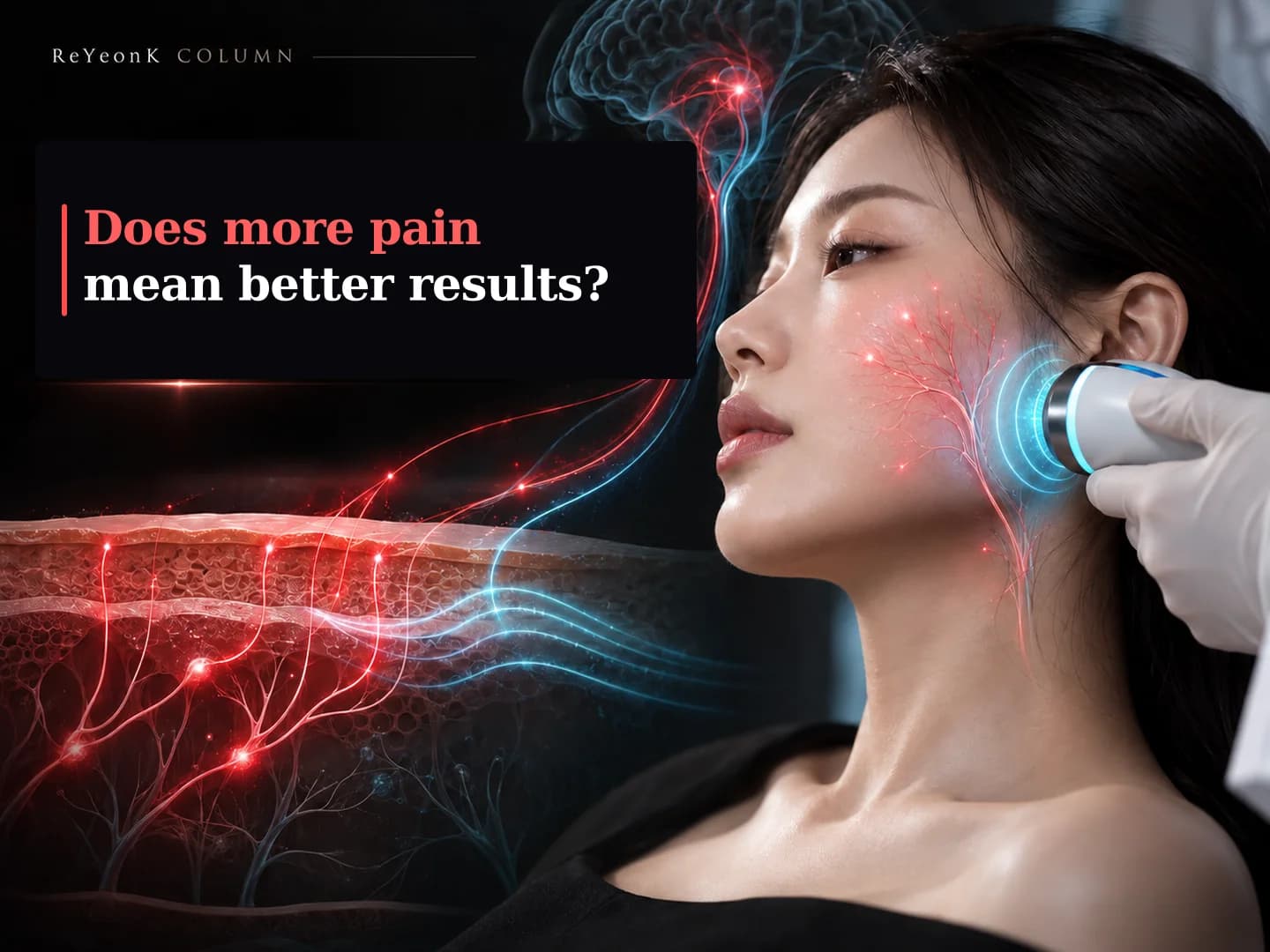
A treatment is not automatically better because it hurts more.
That said, among higher-priced treatments, many deliver high energy to the deeper layers of the skin for a stronger effect, and it is true that pain tends to increase in that process. What matters is not how much it hurt, but whether the necessary energy was delivered safely to the exact layer.
Devices have evolved to deliver strong energy safely
Aesthetic devices have not simply become more powerful. They have developed toward reducing unnecessary stimulation of surrounding tissue, with cooling systems that protect the skin surface and fine control of needle thickness and depth, frequency, energy intensity, and delivery spacing.
Ultherapy delivers ultrasound energy to the target layer while confirming the structures beneath the skin, and Thermage delivers radiofrequency heat to the dermis while cooling the surface. Virtue and Potenza likewise allow control of needle depth and the way energy is delivered.
But a good device does not solve everything. Which layer, how much energy, and at what spacing are ultimately decided by the physician performing the treatment. That is why results and pain differ even with the same device and the same shot count.
What patients worry about most is, in the end, pain
One of the first things patients ask in consultation is, "Does it hurt a lot?"
When you think about it, that is only natural. Without these treatments, most people would almost never have repeated injections in their face over a lifetime. The first time a needle enters the face is unfamiliar and unsettling, and it really can hurt.
I myself was surprised by how much it hurt the first time I had skin botox or Rejuran. Even botox, which I had thought of as relatively simple, hurt quite a bit the first time.
So I do not regard a patient's worry about pain as being oversensitive or lacking patience. It can be frightening the first time, and it can genuinely hurt.
If it hurts too much, you do not want to come back
If the pain is too strong, the patient is left with the memory "I never want that treatment again." Even if it worked, a process that was too hard to endure makes it difficult to continue with the next treatment.
Still, the answer is not to lower the energy needed for the effect just to reduce pain. The necessary energy must be delivered precisely, while avoidable pain is reduced as much as possible.
Pain management at ReYeonK
We do not apply the same anesthesia method to every patient and every treatment. The method needed differs depending on whether the pain is from the needle entering, the pressure of the drug being injected, a sensation of heat, or pain felt in a deep layer.
At ReYeonK, alongside standard numbing cream, we use the following methods as appropriate depending on the type of treatment and the patient's pain sensitivity.
- Ultrasound-assisted penetration of anesthetic using Sonostyler
- Inhaled gas sedation using Airnox
- Nerve blocks for specific areas
- Sleep sedation when needed
- Vibration devices and additional cooling
- Prescribed oral medication to reduce pain and anxiety
- Adjusting treatment speed and energy by area
Using many methods is not what matters. The necessary method should be chosen after checking the patient's health, past anesthesia experience, and the type and extent of the treatment.
I do not believe that a good treatment is one where the doctor just keeps saying "hold on a little longer." Deliver the energy the effect requires safely and precisely, and actively reduce the pain that can be reduced. That is how patients can continue the care they need without fearing treatment.
This is what ReYeonK means by pain management.
Individual pain sensitivity and the appropriate anesthesia or sedation method depend on health status and treatment conditions, and should be decided after a medical consultation.
Treatments in this article
More from the Doctor's Column